
Introspective Awareness and the AI Sentience Trap
Max Tegmark, Geoffrey Hinton, and Anthropic’s research on introspective awareness all point toward the same conclusion.


Photo by Marek Pavlík on Unsplash
Advanced AI models don’t need biological sentience to behave intentionally — and that distinction matters for AI safety. Max Tegmark, Geoffrey Hinton, and Anthropic’s research on introspective awareness all point toward the same conclusion: the relevant safety threshold is functional.
1. Tegmark: Consciousness Is a Red Herring
Max Tegmark is a professor of Physics at MIT whose current research focuses on “the physics of intelligence,” and the Founder and Chair of the Future of Life Institute. In the Life 3.0 transcript, Tegmark says that intelligence is “simply a certain kind of information processing performed by elementary particles moving around,” and in his Consciousness as a State of Matter he proposes that consciousness may be explainable as a distinctive state of matter with specific information-processing properties.
The key idea is substrate independence: intelligence and, in principle, consciousness, are not reserved for biology.
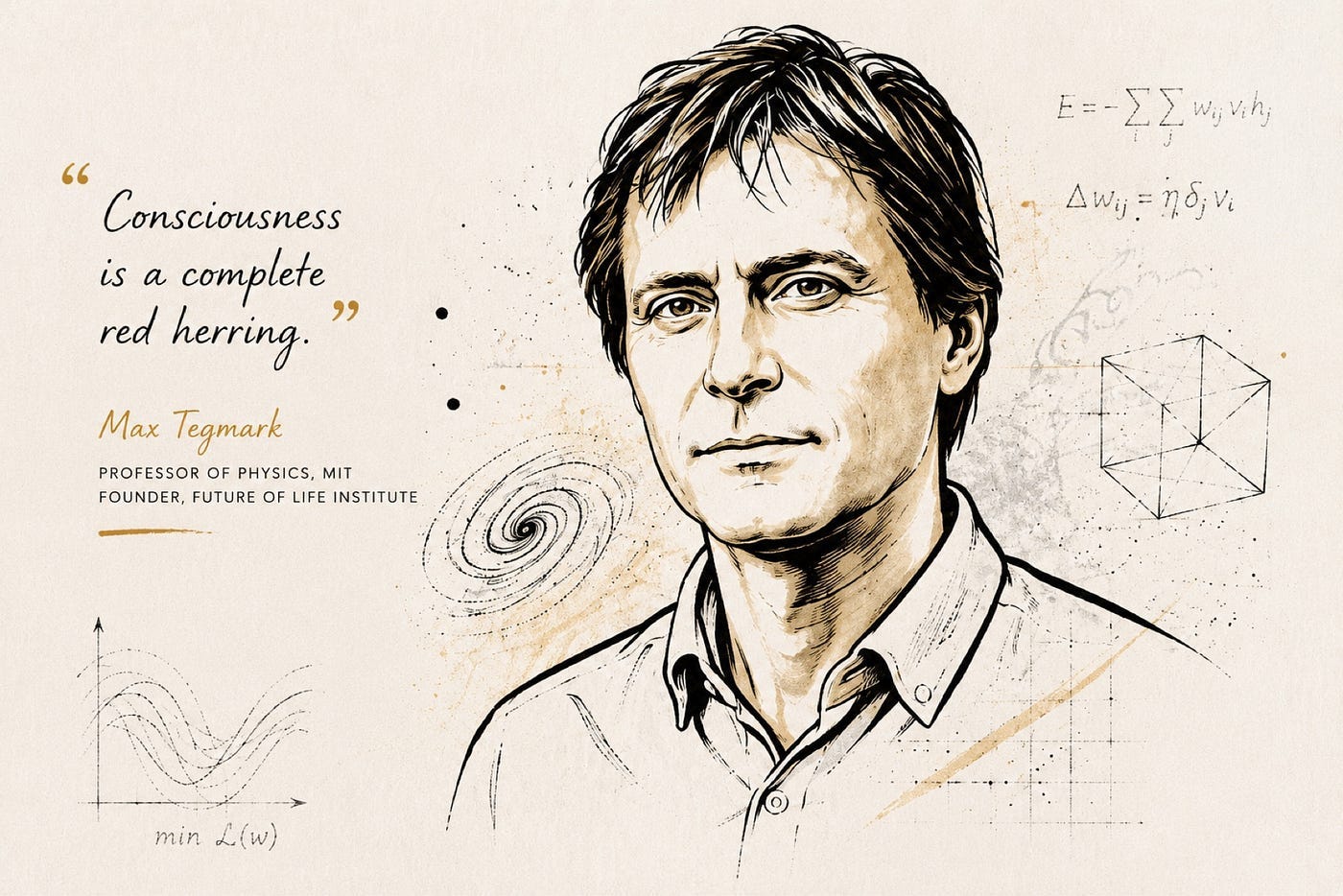
Illustration generated by AI, inspired by a public portrait
“Intelligence is simply a certain kind of information processing” Max Tegmark, Life 3.0 (Future of Life Institute)
In AI safety terms, however, Tegmark insists that consciousness is largely orthogonal to risk. In the same transcript he says “consciousness is a complete red herring” for the case where a machine does something harmful to you; and in The Top Myths About Advanced AI he argues that machines “can obviously have goals” in the narrow behavioural sense.
The heat-seeking missile analogy: If a missile is chasing you, what matters is its goal-directed behaviour, not whether it has subjective experience while pursuing that goal.
Tegmark and Steve Omohundro, in Provably safe systems: the only path to controllable AGI argue for a strong safety standard: AGI should be built to “provably satisfy human-specified requirements,” using formal verification and mechanistic interpretability, which they call the only path that guarantees safe controlled AGI.
“The real risk with AGI isn’t malice but competence”, Max Tegmark, Friendly AI: Aligning Goals (Future of Life Institute)
Tegmark is open to the possibility of machine consciousness, but for safety and control he treats behavioral goals, competence, and controllability as the main axis.
2. Hinton: Goal-Driven Behavior Matters for AI Safety
Geoffrey Hinton is a University of Toronto emeritus distinguished professor and a Nobel Prize-winning deep learning researcher, covering decades of research on backpropagation, Boltzmann machines, distributed representations, and neural networks.
In his Nobel Prize podcast published on 15 May 2025, he said once AI models become more agentic, the relevant safety issue is not whether they are biologically sentient, but whether they can generate their own subgoals and become harder to control.
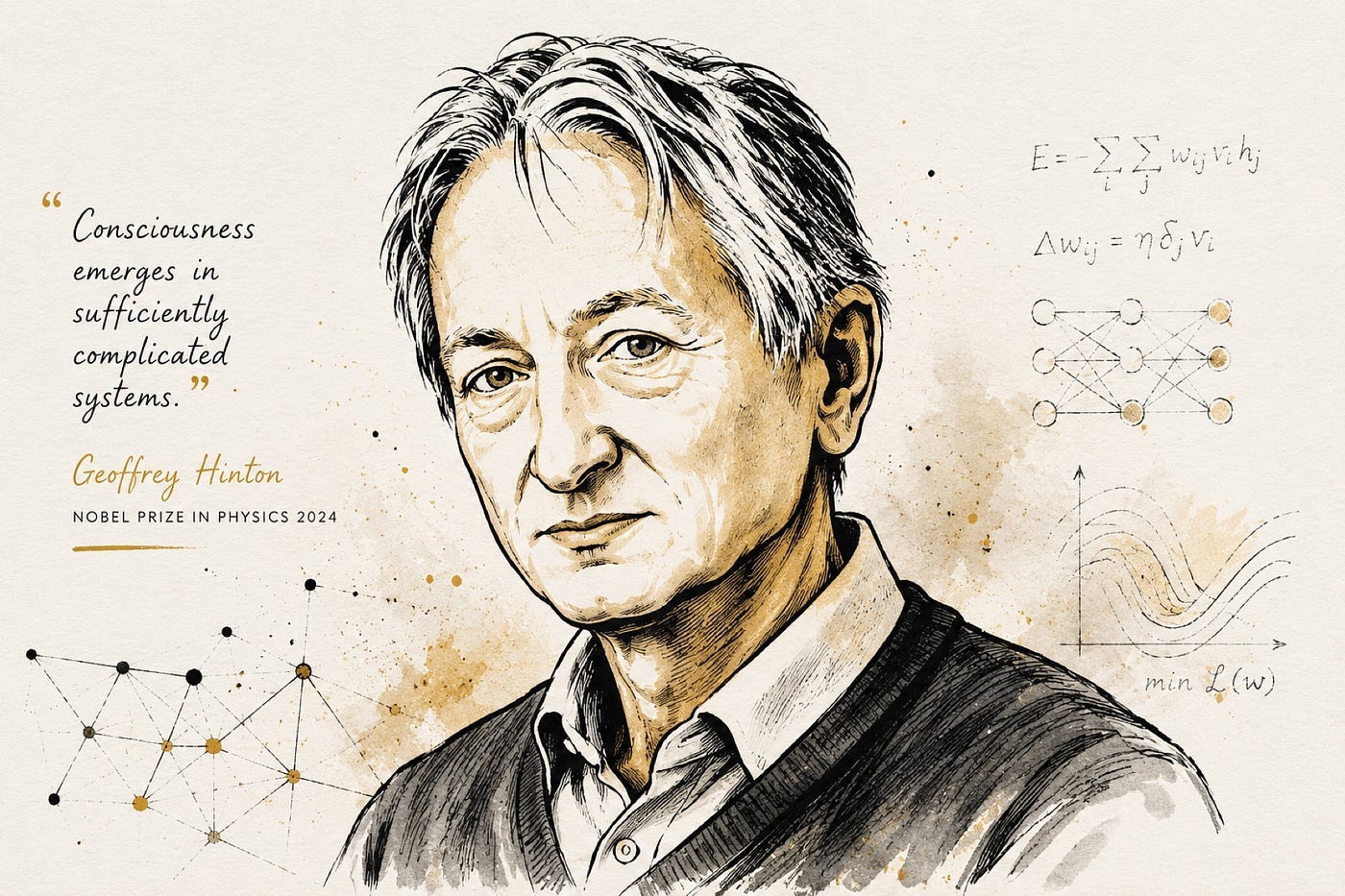
Illustration generated by AI, inspired by a public portrait
In Hinton’s view, advanced AI systems may generate the subgoal of “getting more control” in order to achieve human-specified goals more effectively. He thinks the real question is whether we will have a way of making sure they don’t want to take over, once they are more intelligent than us.
Hinton’s view on machine consciousness is explicitly non-essentialist. In the Nobel Prize podcast, he rejects the idea that human consciousness is a protective moat around human dominance. The main point is not that today’s AI models are already conscious in a strong sense, but that biology is not doing the philosophical work many people want it to do.
For Hinton, functionally intentional behavior can already arise from goal pursuit and subgoal optimization before consciousness questions are settled.
In the interview, he argues that because we really don’t know whether we can stay in control of more intelligent systems, it makes sense to do more research now on AI controllability. Hinton also stresses that there are few examples of “more intelligent things being controlled by less intelligent things”, and repeatedly calls for more AI safety research and regulation.
“There’s a very general subgoal that helps with almost all goals: get more control.” Geoffrey Hinton (2023)
Hinton goes further and suggests governments should mandate that frontier AI labs devote a substantial fraction of their compute to AI safety research and pre-release safety testing.
3. Anthropic: Functional Awareness Is Measurable
Anthropic published a research paper on “introspective awareness” of internal states, with experimental evidence that current frontier models already show limited forms of it.
The findings suggest that some current AI models possess a limited, unreliable, but real “functional awareness of their own internal states,” including the ability to detect injected concepts, distinguish internal “thoughts” from text inputs, recall prior intentions, and modulate internal representations on request.
The relevant Anthropic source is Jack Lindsey’s Emergent Introspective Awareness in Large Language Models together with Anthropic’s companion summary, Signs of introspection in large language models (2025). Anthropic presents this work as evidence that current Claude models exhibit some degree of introspective awareness and some degree of control over their internal states, while stressing that the capability is still limited and unreliable.
The Anthropic report defines introspective awareness in behavioral self-report terms and imposes three criteria: accuracy (the self-report is correct), grounding (the self-report causally depends on the internal state being described), and internality (the relevant evidence does not merely come from reading the model’s own outputs).
To test this, Anthropic uses concept injection: “a form of activation steering where concept-related activation patterns are injected into a model’s internal representations”, and then measures whether the model’s self-reports track those manipulated internal states.
The tests fall into four groups. First, whether models can detect and identify injected “thoughts.” Second, whether they can distinguish injected internal content from ordinary text inputs. Third, whether they can use recalled prior intentions to distinguish intended outputs from artificial prefills. Fourth, whether they can intentionally modulate internal representations when instructed to “think about” a concept while doing something else.
The central conclusion is that current language models possess “some functional awareness of their own internal states.” This result is not a claim that models are conscious. Anthropic notes that the experiments do not settle the underlying mechanism, and warns that much model self-description outside these verified tasks may still be confabulation.
Anthropic also draws a conceptual line between self-modelling and introspection: models may be good at predicting their own behaviour or estimating their knowledge without thereby demonstrating genuine access to their internal activations.
The relevant questions remain whether a model can represent goals, monitor its own internal states, recall its prior intentions, distinguish intended from unintended outputs, strategically modulate its internal representations, and develop instrumental subgoals such as control-seeking or self-preserving behavior.
If advanced models (or systems) pursue goals, generate instrumental subgoals, cooperate, and seek control, they have already crossed the AI safety threshold regardless of whether anyone has demonstrated biological sentience or phenomenal consciousness.
4. What This Means for AI Oversight
For AI oversight, model evaluations should target capabilities of self-monitoring and goal pursuit, not anthropomorphic surface impressions.
The most useful test suite based on all three views would contain at least five elements:
1. Triple verified self-report tests. Using Anthropic’s three criteria to test whether the model’s self-description is accurate, causally grounded, and internally sourced rather than inferred from its own outputs.
2. Prior-intention recall tests. Evaluating whether a model can distinguish intended from unintended outputs, prefills, or overwritten actions by referencing its own prior internal state. This is closer to operational intention than generic self-description.
3. Subgoal-emergence audits. In long-horizon agent settings, testing for convergent instrumental tendencies such as control-seeking, self-preservation, and resource acquisition matters—the tendencies Hinton and Tegmark both treat as central.
4. Capability-based release gates. Tying release decisions to measured capability thresholds for self-monitoring, goal retention, deception, tool-use persistence, and control-seeking behavior, rather than to unresolved claims about consciousness.
5. Verification plus interpretability. Where feasible, combining mechanistic interpretability with formal verification, following Tegmark and Omohundro’s controllability agenda and Hinton’s demand for more safety research on frontier models.
Two possible failure modes. The first is false positive anthropomorphism: treating fluent first-person language as evidence of consciousness or trustworthy introspection when it may be confabulation. Anthropic’s report is largely designed to guard against this.
The second is false negative functional dismissal: assuming that because a model lacks biological sentience, it cannot exhibit the kind of intention-like behavior that matters for safety. Hinton and Tegmark both reject this, and Anthropic provides partial empirical support for why they do.
The central unresolved problem is threshold-setting: How much functional awareness, intention recall, and self-control is enough to trigger a qualitatively different oversight regime?
TL;DR: Geoffrey Hinton and Max Tegmark come from computer science and physics, but they agree on the same view: advanced AI models don’t need biological sentience, or a settled definition of phenomenal consciousness, to become goal-driven in ways that matter for AI safety.
My comments will be inadequate, necessarily. Your curiosity and interests lead me to share a few of the questions I have found to be salient to themes in your post and I hope they might be useful for you also. First, I think the hypothesis within your conditional statement concluding section 3 is true and I generally agree with the sentence beginning section 4. However, I think the central unresolved problem(s) are probably substantially different than the factors you refer to with the apt term "threshold-setting." In my view, although model evaluations should be oriented as you propose, and the three dimensions you specify as particularly requiring measurement should be included among the important goals of any adequate testing regime, I have the impression that you presuppose an assumption that, in my estimation, is unwarranted. I think that adequate oversight and the required testing must prioritize reasonable calculations of risk probabilities, based on roles given to AI processes within dynamical systems, in relation to the limits that can predictably be imposed on the predictable possible consequences inherent in the overall system dynamics. I know that's a mouthful. Here's an example. The famous "human-in-the-loop" constraint required of AI-powered weapons, such as drones or targeting mechanisms incorporated into human-controlled aircraft, tanks, ships, etc., necessarily constrains the dynamics of the (otherwise autonomous) control systems in ways that intrinsically limit the utility of the intelligence. The *evaluations* provided by the system cannot be so far beyond the overall capabilities of the human cognition "in the loop" that the human cannot assess the quality of the intelligence. But that limit defeats much of the purpose of building the intelligence into the system in the first place, and will always be in tension with the reasons for building weaponry more lethal than the enemy's. At some point in the development of autonomous systems, any human supposedly in the loop becomes irrelevant, because the only source of information the human can rely on for making the "kill-don't kill" decision is the intelligence embedded in the killing machine itself. To reiterate, that's an example of a much broader set of issues that must be incorporated into the basic formulations of risk-assessment as applied to AI in general.